Can Victoria's networks turn off my solar?
Emergency Backstop explained: when covered solar can be temporarily curtailed, who it affects and what it does not switch off.
Read guide ↗Practical solar and battery information for Melbourne homes and businesses.
Solar is easier to make sense of when the information follows the decision you're actually making. Start with the section that fits, then go deeper only when you need to.
These guides cover the local questions that can materially change a solar decision: network control, export restrictions, electrical defects and upcoming rental electrification requirements.
Emergency Backstop explained: when covered solar can be temporarily curtailed, who it affects and what it does not switch off.
Read guide ↗Why zero-export approvals happen, whether solar can still save money and where batteries or self-consumption fit.
Read guide ↗Energy Safe Victoria's recurring renewable-energy defect categories translated into practical checks for households comparing or reviewing an installation.
Read guide ↗The phased heating, cooling, hot-water, insulation and draughtproofing standards, plus where solar fits.
Read guide ↗Start with the basics: how solar works, what common system sizes mean and how to make sense of the proposal in front of you.
Short answers on sizing, batteries, rebates, exports, blackouts, quotes and installers.
Read guide ↗The full buyer journey from sizing and quotes through network approval, installation, inspection, exports and warranties.
Read guide ↗Melbourne production, roof-space needs, common inverter pairing and when a larger array makes more sense.
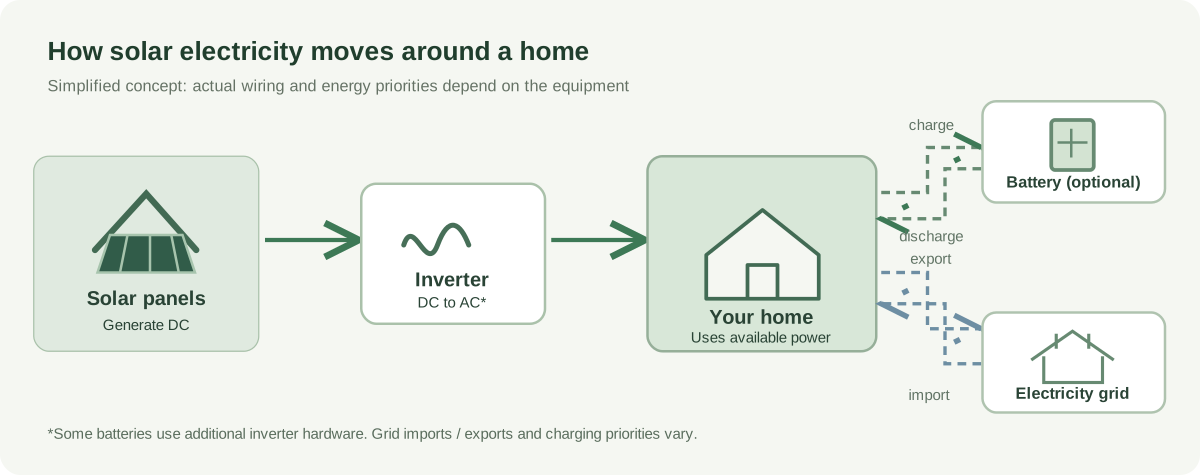
Read guide ↗Photons, silicon, moving electrons and the inverter, explained with simple analogies.
Read guide ↗A decision framework for older systems covering panels, inverter age, roof space, new loads, exports and incentives.
Read guide ↗Separate battery capacity from battery power, understand backup capability and work out whether storage suits the way your household uses electricity.
Usable kWh, output kW, evening demand, winter solar, backup, EVs and Victoria's midday charging opportunity.
Read guide ↗AC and DC coupling, hybrid-inverter replacement, microinverters, three-phase homes, backup and network approval.
Read guide ↗Essential circuits, partial-home and whole-home backup, runtime, surge loads, solar recharging and three-phase complications.
Read guide ↗Keep the money separate from the hardware: system price, government incentives, feed-in tariffs and changes to Victorian electricity plans.
A transparent framework for equipment, roof work, switchboards, batteries, backup, incentives and published price benchmarks.
Read guide ↗Understand the Victorian PV rebate, interest-free loan and where to check current eligibility.
Read guide ↗The closed Victorian loan, current federal STCs, battery-size tapering and the January 2027 factor change.
Read guide ↗The live 11 am-2 pm no-cost window, daily limit, outside-window tariffs and what it changes for batteries, EVs and appliances.
Read guide ↗Why a high export rate can still lose once usage prices, supply charges, time-of-use periods and household demand are included.
Read guide ↗These rules can affect inverter choice, export capacity, communications and system design. Start here when the network or switchboard is part of the question.
Static, flexible and zero-export arrangements, plus the difference between array, inverter and export capacity.
Read guide ↗How dynamic export limits work across Victorian distributors, including inverter and internet requirements.
Read guide ↗Why zero-export approvals happen, whether solar can still save money and where batteries or self-consumption fit.
Read guide ↗Emergency Backstop explained: when covered solar can be temporarily curtailed, who it affects and what it does not switch off.
Read guide ↗Why modern inverters communicate with Victorian networks, the late-2026 v1.2 transition and how to check an exact model.
Read guide ↗Solar, batteries, EV charging, heat pumps, induction, pools and when a three-phase upgrade actually solves a problem.
Read guide ↗Know what happens after you accept a quote, what good electrical work should look like and what paperwork, warranties and support should still be there afterwards.
Compare array and inverter size, exact models, battery power, warranties, scope, finance, rebates and exclusions consistently.
Read guide ↗DNSP pre-approval, rebate approval, installation, electrical paperwork, independent inspection, metering and monitoring handover.
Read guide ↗LEWs, RECs, LEIs, prescribed electrical work, Certificates of Electrical Safety, timing and what happens if a defect is found.
Read guide ↗Energy Safe Victoria's recurring renewable-energy defect categories translated into practical checks for households comparing or reviewing an installation.
Read guide ↗Why electrical servicing is different from cleaning, what gets checked and who should do it.
Read guide ↗A transparent framework covering trading history, workmanship, technical capability, reviews, support and quote transparency.
Read guide ↗Pressure tactics, vague product models, unsupported savings, unclear subcontracting, missing exclusions and independent claim checks.
Read guide ↗Panel, inverter, battery and workmanship warranties, consumer guarantees and who should help when something goes wrong.
Read guide ↗Solar sizing changes when the home itself changes. Use these guides when EV charging, heating, hot water, rental standards or shared property are part of the plan.
Design around the 2027 all-electric requirements, roof space, three-phase power, switchboards, EV charging and future storage.
Read guide ↗Household sockets, Level 2 charging, solar surplus, batteries, the Midday Power Saver, switchboard capacity and load management.
Read guide ↗Daytime operation, timers, thermal storage, current Victorian incentives and how hot water changes household solar demand.
Read guide ↗The phased heating, cooling, hot-water, insulation and draughtproofing standards, plus where solar fits.
Read guide ↗Current funding, Owners Corporation approval, shared solar, renters, embedded networks and relevant lot rules and exemptions.
Read guide ↗Use first-party and official datasets to see what is being installed, then check manufacturers and exact product documentation separately.
A repeatable Solar Victoria data format for panel, inverter and battery installation files, with explicit coverage limits and manufacturer profiles.
Read guide ↗Explore the equipment and manufacturer library ↗ · Explore Victorian solar data ↗
Interval-data sizing, VEU and federal incentives, network studies, industrial sites, batteries, future electrification and ROI methodology.
Explore commercial solar ↗Compare introductory Melbourne solar, inverter and battery scenarios using your household details.
Plan my system ↗Describe occupants, appliances and when people are home to build a simpler picture of electricity demand.
Build my household ↗Estimate outage duration from usable battery capacity, reserve, average backup load and optional islanded solar support.
Estimate runtime ↗Use the suburb directory for researched local guides and planning information, while keeping roof suitability and network approval property-specific.