What should a Melbourne solar system cost?
For a straightforward residential installation in late 2026, a practical comparison range is about $6,000 to $9,000 for a 6.6 kW system and about $9,000 to $12,000 for a 10 kW system, including GST and after the usual federal solar STC point-of-sale discount, but before any Solar Victoria rebate.
| System size | Useful comparison range after solar STCs | Context |
|---|---|---|
| 6.6 kW | $6,000–$9,000 | Common residential size; published quality-market range |
| 10 kW | $9,000–$12,000 | Larger households, electrification and stronger daytime demand |
Melbourne-specific Solar Choice data published for July 2026 was lower at the standard end of the market: $5,810 for 6 kW and $8,890 for 10 kW, including GST and the federal STC discount. That is useful evidence that legitimate quotes can sit below the broader quality-system ranges above.
The right conclusion is not that one source is correct and the other is wrong. They describe different samples and equipment mixes. Melbourne Solar Guide therefore uses ranges and dated benchmarks rather than presenting one number as the universal Melbourne price.
How we set these price ranges
We checked current independent solar pricing, current published Melbourne benchmarks and the incentive rules that affect what appears on a quote. We do not average together every advertised package because a basic single-storey installation and a premium system with switchboard work, optimisers or backup hardware are not the same product.
Our pricing method
- Use dated installed-price references rather than undated advertising claims.
- Keep the federal solar STC discount separate from the Victorian Solar Homes rebate.
- Treat the Solar Victoria interest-free loan as finance, not another rebate.
- Flag roof, switchboard, phase, backup and other scope differences that can legitimately change the quote.
- Show assumptions when an example depends on postcode, STC quantity or certificate value.
Current SolarQuotes pricing, updated on 12 October 2026, reports typical fully installed costs of $6,000–$9,000 for 6.6 kW and about $9,000–$12,000 for 10 kW. Its figures reflect what buyers reported paying and include the federal solar incentive. The Melbourne-specific July benchmark above comes from the Solar Choice Price Index.
What does a 6.6 kW or 10 kW solar system cost?
6.6 kW solar system
Use roughly $6,000–$9,000 after solar STCs and before the Victorian rebate as a current quality-system comparison range. A straightforward value-oriented package can cost less. Premium modules, microinverters, difficult roof access or extra electrical work can push the installed price higher.
A 6.6 kW array should not be chosen simply because it is a familiar package size. Roof space, electricity use and future loads matter. See when a 6.6 kW system is enough for a Melbourne home ↗
10 kW solar system
Use roughly $9,000–$12,000 after solar STCs and before the Victorian rebate as a current comparison range. The Melbourne standard-tier benchmark published in July 2026 was $8,890, showing that uncomplicated installations can fall below that broader quality-system band.
A 10 kW array can suit homes with higher daytime use, electric heating and cooling, heat-pump hot water, a battery, EV charging or planned electrification. But a larger array only makes sense when the roof, connection approval and expected energy use support it.
Use the solar and battery calculator before comparing package prices ↗
Before rebate, after rebate and after STCs: what do the prices mean?
Victorian solar advertising can blur several different incentives together. For a homeowner, there may be four separate numbers:
- the gross installed retail price;
- the federal solar STC discount;
- the Solar Victoria PV rebate, if the household is eligible; and
- an optional Solar Victoria interest-free loan.
The loan is not another rebate. It changes when part of the system is paid for; it does not make that amount free.
Federal solar STCs depend on postcode and installation year
The number of solar STCs depends on the array size, installation postcode and installation year. For systems installed in 2026, the solar deeming period is five years. It falls to four years for installations in 2027.
Melbourne is not one uniform STC zone. The Clean Energy Regulator lists postcodes 3000–3035 as Zone 4, for example, while 3036–3038 are Zone 3. Other Zone 3 and Zone 4 changes occur across metropolitan Melbourne, so use the actual installation postcode rather than assuming every Melbourne property receives the same certificate quantity.
| Array size | 2026 Zone 4 calculation | Indicative STCs |
|---|---|---|
| 6.6 kW | 6.6 × 1.185 × 5 | 39 |
| 10 kW | 10 × 1.185 × 5 | 59 |
STCs have a market value rather than one permanent retail dollar amount. Most homeowners assign the right to create them to a registered agent in return for an upfront reduction in the quoted price. Ask the retailer to show the STC quantity and the dollar value it has applied.
Solar Victoria rebate
Eligible Victorian households can currently receive a solar PV rebate of up to $1,400. From 1 July 2026, the standard owner-occupier income test is combined taxable income of all owners of less than $150,000 per year, and the property value must be below $3 million. Other eligibility rules also apply.
The rebate is up to 50% of the purchase cost, capped at $1,400, and is calculated after other discounts including solar STCs have been applied.
Solar Victoria also offers an optional interest-free loan of up to the value of the rebate. A full $1,400 loan is repaid over four years at $29.17 per month. Again, that loan is finance, not an extra $1,400 discount.
Do not install before Solar Victoria confirms eligibility. Solar Victoria states that a system installed before eligibility approval will not receive the rebate.
Check the full Solar Victoria eligibility rules before relying on the rebate in a budget ↗
Worked example: separating the solar price from the incentives
Suppose a Zone 4 Melbourne property is offered a 6.6 kW system with a gross installed retail price of $8,500.
| Step | Amount | What it means |
|---|---|---|
| Gross installed price | $8,500 | Before assigning solar STCs or applying the Victorian rebate |
| 39 solar STCs at an illustrative $38.50 each | −$1,501.50 | Example only; certificate market values can change |
| Price after solar STCs | $6,998.50 | This is the useful like-for-like figure for comparing retailer pricing |
| Full Solar Victoria rebate, if eligible | −$1,400 | State rebate, not available to every household |
| Net purchase cost | $5,598.50 | Before choosing any optional loan |
If the household also qualifies for and chooses the matching $1,400 interest-free loan, the purchase cost does not fall to $4,198.50. Instead, roughly $4,198.50 would remain to be funded outside the loan and the $1,400 loan would then be repaid over four years.
This is why advertisements that combine a rebate and a loan into one large “government support” number can be misleading unless the repayable portion is clearly identified.
What should be included in an advertised solar price?
A useful written quote should make it possible to understand exactly what you are buying. At minimum, check the panel model, inverter model and size, mounting system, installation labour, electrical scope, monitoring, warranties, GST and the solar STC deduction.
Also establish whether the quote includes or excludes:
- switchboard upgrades or protection changes;
- meter work;
- difficult or multi-storey roof access;
- tile or roof repairs;
- optimisers or microinverters;
- long cable runs;
- three-phase equipment;
- export-control hardware;
- inspection and compliance charges;
- backup hardware when a battery is included; and
- removal of an old solar system.
Two quotes can use similar panels and inverters and still differ by thousands of dollars because the houses and the installation scopes are different.
Why do solar quotes vary so much?
Equipment
Panel efficiency, warranty terms, inverter architecture, hybrid capability, three-phase equipment and module-level electronics can all change the cost. Compare exact model numbers rather than assuming every product from one brand sits in the same tier.
Roof and labour
A simple single-storey metal roof is not the same job as a steep tiled roof with several faces, difficult access, shading or long cable routes. Roof condition also matters if panels may have to be removed again for repairs.
Switchboard and electrical work
An older switchboard or unusual meter arrangement can require work beyond the panels and inverter. A quote that includes required electrical upgrades may initially look more expensive than a quote that leaves them as a later variation.
Network and export requirements
The amount of solar on the roof and the amount the property can export are different questions. Network approval, export controls and inverter compatibility can affect the design and, in some cases, the price.
Understand Victorian solar export limits ↗ · See how zero-export solar works ↗
How much does adding a battery change the price?
A battery can add more to the project cost than increasing the solar array because the job can involve battery modules, inverter or gateway hardware, metering, communications, switchboard work, backup switching and additional protection.
A simple 10 kWh battery example used in current Australian battery economics is around $9,500 installed after the federal battery incentive, but real product and installation prices vary materially. Backup capability, inverter replacement and larger batteries can push the project substantially higher.
The federal battery incentive is separate from the solar-panel STC calculation and changed during 2026. Do not estimate it using old 2025 or early-2026 articles.
Use the current federal battery rebate guide ↗ · See what changes when adding a battery to existing solar ↗
How should you compare two Melbourne solar quotes?
Put every proposal on the same basis. Compare the installed price after the federal solar STC discount but before assuming a Solar Victoria rebate. Then compare the equipment, inverter size, roof and electrical scope, warranties, monitoring and exclusions.
Only subtract the state rebate once eligibility is confirmed, and never treat the interest-free loan as a discount.
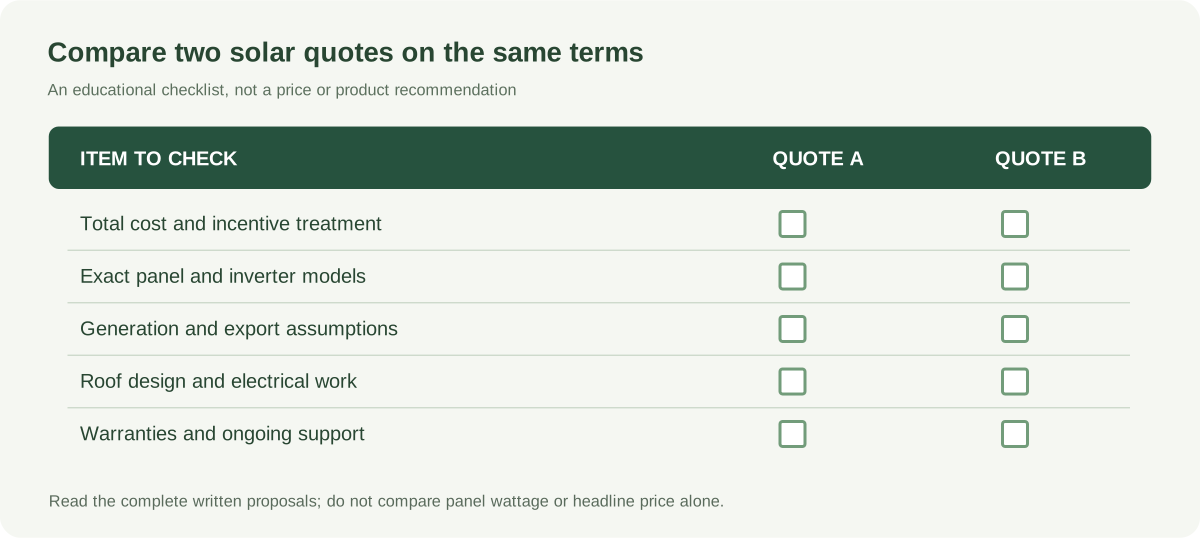
Use the full solar quote comparison framework and downloadable table ↗
Size the system before shopping for the cheapest package.
Use the solar and battery calculator to establish a sensible system-size range, then compare like-for-like written quotes.
START MY ASSESSMENTCommon Melbourne solar price questions
How much does a 6.6 kW solar system cost in Melbourne?
About $6,000–$9,000 after federal solar STCs and before the Solar Victoria rebate is a useful late-2026 quality-system comparison range. Straightforward standard-tier installations can be cheaper, while premium or complex installations can cost more.
How much does a 10 kW solar system cost in Melbourne?
About $9,000–$12,000 after federal solar STCs and before the Solar Victoria rebate is a useful current comparison range. Solar Choice's July 2026 standard-tier Melbourne average was $8,890.
Does every Victorian get $1,400 off solar?
No. The Solar Victoria PV rebate is means-tested and subject to property and program-history requirements. From 1 July 2026, the standard owner-occupier income threshold is combined taxable income of all owners below $150,000, with a property-value threshold below $3 million and other conditions.
Is the $1,400 interest-free loan another rebate?
No. It is repayable over four years. A full $1,400 loan currently equates to $29.17 per month.
Does all of Melbourne receive the same solar STC discount?
No. Solar STC zone ratings vary by postcode. Some Melbourne postcodes are Zone 4 and others are Zone 3, so the installation postcode must be used in the entitlement calculation.
Will the federal solar STC discount fall in 2027?
Yes. The solar deeming period falls from five years for a 2026 installation to four years for a 2027 installation, so an otherwise equivalent system creates fewer solar STCs.
Is a cheap solar quote automatically bad?
No. A lower price can come from an uncomplicated roof, competitive equipment buying or lower margins. The warning sign is a price that cannot be explained because the equipment, scope, installer, exclusions or after-sales support are unclear.
Sources and further reading
Editorial references checked: 12 October 2026Source labels identify who published each reference, not an independent endorsement. Confirm current requirements and exact product terms before purchasing.
- Industry price indexSolarQuotes: Solar Panel Cost in Australia: What You Should Pay in 2026 ↗: Updated 12 October 2026; current quality-system price ranges used as a broad market reference.
- Industry price indexSolar Choice: Solar Panel Price Index ↗: Melbourne July 2026 installed-price benchmark; includes GST and the federal STC discount.
- Government sourceSolar Victoria: solar panel (PV) rebate ↗: Current rebate value, income and property thresholds, application sequence and interest-free loan terms.
- Government sourceClean Energy Regulator: calculate STC entitlements ↗: Solar deeming periods and STC calculation framework.
- Government sourceClean Energy Regulator: postcode zone ratings for solar panel systems ↗: Official postcode ranges and Zone 3/Zone 4 ratings used to avoid treating all Melbourne postcodes as one solar zone.
- Industry price indexSolarQuotes: are solar batteries worth it? ↗: Current 10 kWh installed-cost assumption after the federal battery incentive; used only as a battery cost example.