Can most existing solar systems have a battery added?
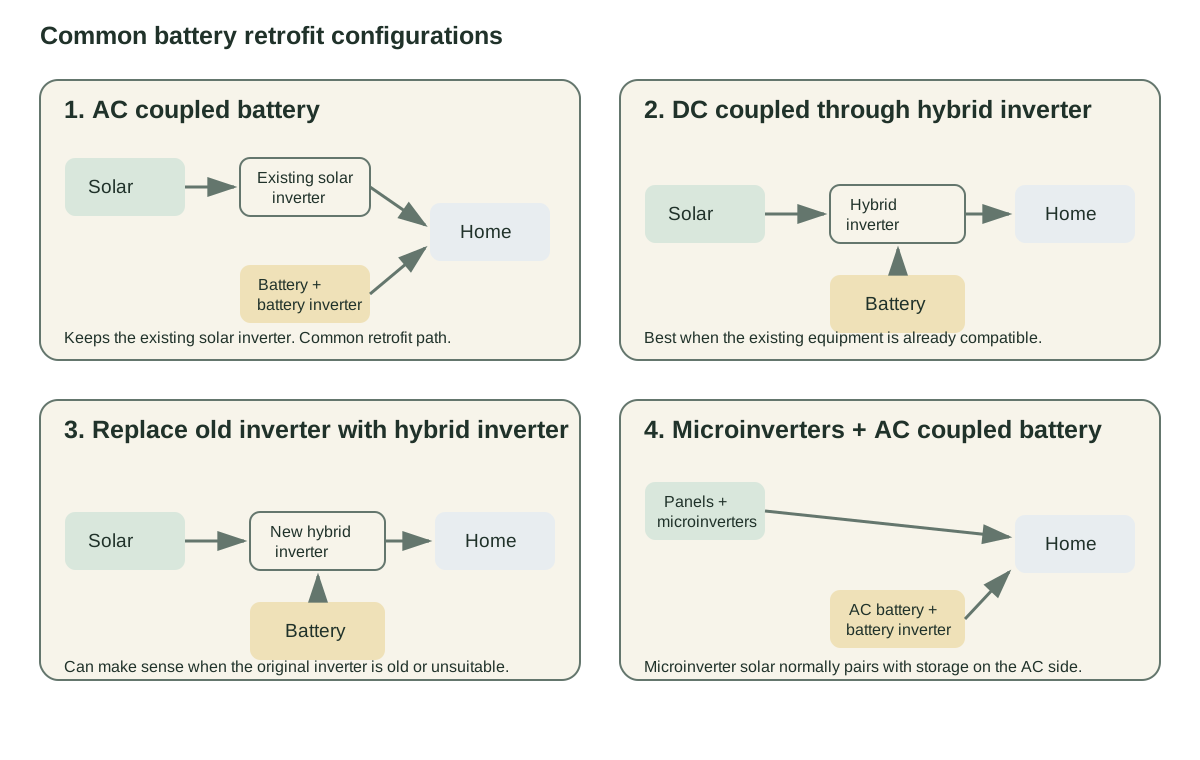
Usually, yes. A battery does not have to use the same inverter as the existing solar. A retrofit can keep a working solar inverter and add separate battery power-conversion equipment, or the existing inverter can be replaced with a compatible hybrid inverter where that produces a better overall design.
Before choosing the battery, identify the existing inverter model and age, solar-array size, number of phases, smart-meter import/export history and whether blackout backup is a real requirement. Those facts determine which options are practical.
Do not accept "you need a new inverter because you're adding a battery" as a complete explanation. Sometimes replacement is sensible; sometimes it adds cost without enough benefit.
Battery retrofits are now a major part of the market
The Clean Energy Regulator's June-quarter 2026 report shows that batteries installed on existing solar systems represented 55% of validated installations in April and around 42% across May and June.
The Regulator defines a retrofit in this dataset as a battery installed more than 90 days after the associated solar PV installation. It also cautions that recent retrofit shares can be revised down because batteries installed alongside new solar may take longer to be submitted and validated.
That is useful context, not a reason to buy a battery. The household case still depends on how much electricity you import after solar production falls, how much solar you export, tariffs, battery cost and what you want the system to do.
The four common battery retrofit configurations
What is AC coupling?
With AC coupling, the existing solar inverter continues turning panel DC electricity into household AC electricity. The battery has its own inverter or power-conversion equipment connected on the AC side of the home.
This is often the least disruptive retrofit when the existing solar system is healthy. It can also work well with systems that were never designed for a battery. The trade-off is that solar energy stored in the battery can pass through more conversion stages than in a direct DC-coupled design.
AC coupling is one reason an existing conventional solar inverter does not automatically need to be replaced.
What is DC coupling?
With DC coupling, solar panels and the battery are managed through compatible hybrid power-conversion equipment before household AC is supplied. It can reduce conversion steps and create a tidy integrated system, but compatibility between the array, inverter and battery matters.
If the existing solar inverter is already a compatible hybrid model, adding a supported battery may be relatively straightforward. If it is not, a DC-coupled retrofit can require replacing the inverter.
Should you keep the existing inverter or replace it?
Keeping a healthy inverter can make sense where an AC-coupled battery provides the required functionality without compromising the rest of the design.
Replacement becomes more rational when the inverter is ageing or unreliable, has failed, limits a planned solar expansion, is incompatible with the preferred storage architecture or cannot deliver the backup design you want.
Current federal battery rules do not create a blanket requirement to replace every existing solar inverter. For an eligible retrofit, the inverter arrangement connected to the battery has relevant technical requirements, but other existing solar inverters at the property do not automatically have to be VPP-capable simply because a battery is added.
In Victoria, changing solar inverter equipment can also trigger current distributor connection and emergency-backstop requirements. Include those compliance implications in the decision rather than treating an inverter swap as a simple appliance replacement.
Can a house with microinverters add a battery?
Yes. Because panel-level microinverters already convert solar to AC at the roof, storage is commonly added on the AC side using compatible battery equipment. The existing solar can continue operating as its own generation system.
Blackout behaviour still needs careful checking. Some combinations can operate solar and storage while islanded; others may provide battery backup without allowing all existing solar microinverters to keep producing during an outage.
Can an older solar system have a battery added?
Age alone does not make a system unsuitable for a battery, but it changes the economics and the design checks. Review panel condition, inverter reliability, monitoring, roof condition, warranties and whether the array produces enough surplus to support the proposed storage through different seasons.
For a system around 10 to 15 years old, compare three options side by side: keep the existing solar unchanged, expand it where practical, or replace older solar equipment as part of one redesign. Victoria's current PV rebate rules also contain a pathway that may apply to eligible properties with solar installed 10 or more years ago. See the old solar upgrade and replacement guide ↗ and current Victorian rebate guide ↗.
What battery suits an existing 6.6 kW solar system?
There is no single battery size that automatically matches a 6.6 kW solar array. Two homes with the same panel capacity can have very different evening imports, daytime exports and winter generation.
Use the property's own data. The most useful figures are how much electricity is imported after solar production falls, how much solar is normally exported during the day, how those figures change by season, and whether future loads such as an EV or heat-pump hot water are likely to change the pattern.
If the home exports 12 kWh on a typical sunny day but only imports 4 kWh overnight, a very large battery is solving a different problem from a home that imports 18 kWh after sunset. Solar-array size by itself does not answer the storage question.
Battery sizing: usable kWh, output kW and measured household demand
Usable capacity in kWh tells you how much stored energy is available. Battery or inverter output in kW tells you how much power can be delivered at one time. Both matter.
A battery can hold plenty of energy and still be unable to run every large appliance simultaneously. That distinction becomes especially important when backup is part of the purchase decision.
For an existing-solar home, smart-meter and monitoring history are more valuable than a generic battery-size table. Review several seasons where possible rather than sizing from one unusually sunny bill.
How does three-phase power affect a battery retrofit?
A three-phase house does not automatically require a three-phase battery, but the phase arrangement matters for metering, power flow and especially backup. Some systems back up selected circuits on one phase; others support selected loads across phases; some are designed for broader three-phase backup.
Ask the quote to state exactly which phases and circuits remain powered in an outage and the continuous backup output available. For the wider decision, see single phase versus three phase power ↗.
Does adding a battery automatically give you blackout backup?
No. Ordinary battery operation while the grid is available and backup operation during an outage are different functions.
Backup needs compatible inverter functionality, safe isolation or islanding equipment and an electrical design that defines which loads remain energised when the grid fails. Depending on the system, that might be a small group of essential circuits, selected circuits across the house or a broader whole-home arrangement.
If backup matters, have the proposal state which circuits and phases are backed up, maximum continuous backup output, whether rooftop solar can continue charging the battery while the grid is down, and what happens when the battery reaches its reserve level. Read the blackout backup guide ↗.
Can a retrofit battery charge from the grid?
Many modern battery systems can charge from the grid as well as from rooftop solar, subject to the product, settings, tariff and applicable network or program requirements.
That can matter where a retailer offers a cheap or no-cost daytime window, or where winter solar production is insufficient to refill the battery. The financial result depends on the difference between charging and avoided-import prices, battery losses, cycle behaviour and the household load profile.
Do not size a battery on the assumption that rooftop solar will fill it every day if the home's winter production history says otherwise. See the Victorian midday tariff guide ↗ for one current tariff structure relevant to this decision.
Does adding a battery affect network approval or Victoria's emergency backstop?
It can. Distribution businesses assess the site's existing and proposed inverter equipment, phase arrangement and export capability. A battery may also change export behaviour even where the solar panels themselves are unchanged.
Victoria's emergency backstop applies to new rooftop solar systems up to 200 kW and to many upgraded or replacement solar installations from 1 October 2024. A battery-only inverter that is not connected to PV can be treated differently from a hybrid inverter that also controls solar generation, so the exact configuration matters.
Do not assume an installer can simply preserve an old connection arrangement after changing inverter equipment. The retailer or installer should obtain any required distributor approval and explain the final export limit, internet or communications requirements and backstop setup before installation.
Should you add more solar panels at the same time?
Sometimes. Extra solar becomes more compelling where the existing array regularly produces too little surplus to charge the proposed battery, particularly in winter, or where the household is adding material new electrical loads.
If the existing array already exports considerably more energy than the battery could store on many days, extra panels may provide less benefit. Expansion can also change inverter design, current standards, network approval and incentive eligibility.
Previously rebated or STC-claimed panels do not simply earn a second round of solar STCs because they are rewired into a new inverter. Compare the complete project rather than assuming every reused component attracts a fresh incentive.
What determines battery retrofit cost?
There is no responsible single "battery retrofit cost" that applies to every existing-solar home. The finished price can change with battery modules, inverter or gateway architecture, switchboard work, protection equipment, cable routes, phase configuration, backup switching, inverter replacement and any simultaneous solar expansion.
For useful quote comparison, separate the price into the battery and standard installation, inverter or gateway equipment, blackout-backup equipment, switchboard or electrical upgrades, and any solar-system changes. That makes it much easier to see why two apparently similar proposals differ.
The current federal battery STC incentive can reduce eligible installation cost. Use the federal battery rebate calculator and guide ↗ to see the certificate calculation rather than relying on a fixed advertised dollar amount.
Use your measured history to size the battery
An existing solar household has better sizing data than a new installation. Use smart-meter imports, solar generation and exports to work out how much energy is available to charge the battery and how much grid energy you actually buy after sunset.
Size the retrofit from your real household pattern.
Use the Melbourne Solar Guide battery-size calculator and enter the existing solar system rather than starting from a blank house.
START MY ASSESSMENTSources and further reading
Editorial references checked: 19 October 2026Source labels identify who published each reference, not an independent endorsement. Confirm current requirements and exact product terms before purchasing.
- Government sourceClean Energy Regulator: Q2 2026 consumer energy resources ↗: Current validated battery-installation data, retrofit definition and warning that recent retrofit shares can be revised.
- Government sourceAustralian Government: Batteries ↗: Battery integration, AC and DC coupling, backup and retrofitting storage.
- Government sourceSolar Victoria: Solar battery systems explained ↗: Existing-system retrofits, hybrid and battery inverters, grid charging and backup.
- Government sourceClean Energy Regulator: Solar batteries ↗: Current federal battery eligibility and requirements when batteries are added to existing solar.
- Government sourceVictorian Government: Emergency backstop for solar ↗: Current Victorian requirements for new, upgraded and replacement rooftop solar.