When should an old solar system be kept, expanded or replaced?
Start with four questions: is the existing equipment safe and working, is the array still large enough for the household, is there useful roof space left, and will the next major change be a battery, EV or electrification upgrade?
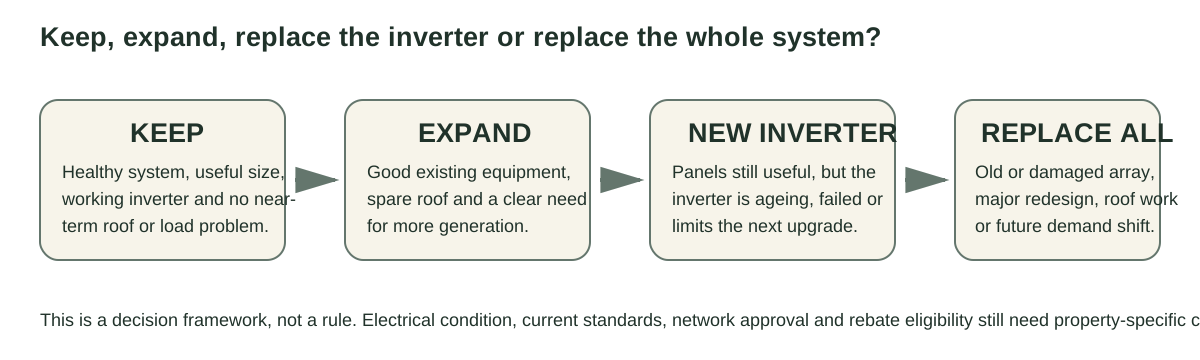
If the system still produces well and the home has not changed much, keeping it can be the best-value decision. If the panels are healthy but the inverter is ageing, inverter replacement may be enough. If the array is undersized, expansion or a second system may be sensible. Full replacement becomes easier to justify when the panels, inverter and original design are all reaching the end of their useful role.
A simple old-solar decision flow
System age matters, but condition matters more
Look at the installation date, panel condition, inverter fault history, monitoring data, electrical service history and remaining warranties. An inverter may reach a replacement decision before the panels do.
Have older systems serviced by an appropriately licensed electrician rather than judging condition from the roofline. If roof work is planned, coordinate it with the solar decision so panels are not removed and reinstalled twice.
Compare the old system with the home you have now
Many systems installed 10 to 15 years ago were designed around a very different household. EV charging, heat-pump hot water, electric heating and cooling, induction cooking, pool equipment and batteries can all lift electricity demand or shift when energy is used.
A small older array can still be useful, but future electrification may make additional generation more valuable. Model the future home rather than simply replacing the old array with the same kW.
Roof space and inverter condition shape the upgrade path
If the remaining roof has a good unshaded section, an additional system can sometimes be cleaner than disturbing a healthy original array. If the existing inverter has failed or cannot support an expansion, a new inverter may be needed.
When older panels are connected to a new inverter, the installer must consider current standards and re-certification obligations. Do not assume every old string can simply be transferred unchanged.
Will the old export limit carry over?
Not necessarily. A network connection offer relates to the approved installation. Expanding, altering or replacing inverter equipment can require new pre-approval and may expose the property to current export settings, flexible-export options and Victoria's emergency-backstop requirements.
That does not mean an upgrade is a bad idea. It means the new network offer should be known before the financial comparison is finalised. See current Victorian export limits ↗.
How do federal STCs work for extensions and replacements?
The Clean Energy Regulator treats several upgrade paths differently.
Current CER treatment
- Add panels using the existing inverter: an eligible extension can create STCs for qualifying new panels if the enlarged system and equipment meet current rules.
- Add new panels and a new inverter: the new components can qualify, but existing panels that already received STCs cannot be included in the new STC claim.
- Install a separate second system: the new system can qualify as an additional system if the combined small-scale capacity and equipment meet the current scheme rules.
- Replace the entire system: a new replacement system can qualify where the original is removed and the new panels and inverter meet current eligibility rules.
- Replace only some or all panels while keeping previously claimed components: that update is not automatically eligible for new STCs simply because panels were changed.
The installer must use the correct claim type and cannot claim STCs again for equipment that has already been used in a prior STC claim.
Can an older Victorian system qualify for the Solar Homes PV rebate?
Solar Victoria's current rules allow eligible households with a solar PV system installed at least 10 years ago to potentially use the solar panel rebate to replace or expand it. The normal household, property, prior-rebate and authorised-retailer requirements still apply.
This Victorian rebate is separate from federal STCs. Eligibility for one should not be assumed to prove eligibility for the other.
What should you compare before deciding?
- Installation date and service history.
- Actual annual generation and inverter fault history.
- Panel condition and remaining warranty.
- Current array and inverter size.
- Usable roof space and any planned roof replacement.
- EV, heat-pump, battery and future electric loads.
- Current and proposed DNSP export arrangement.
- Cost of keeping, expanding, inverter-only replacement and full replacement as separate options.
- Which new components genuinely qualify for STCs or Solar Victoria support.
Model the future household before replacing the past.
Use the solar and battery calculator to test a larger modern load profile, then compare that result with what the old system currently produces.
START MY ASSESSMENTSources and further reading
Editorial references checked: 5 October 2026Source labels identify who published each reference, not an independent endorsement. Confirm current requirements and exact product terms before purchasing.
- Government sourceClean Energy Regulator: expanding, upgrading or replacing solar PV ↗: Current STC rules for extensions, additional systems, inverter changes and complete replacements.
- Government sourceSolar Victoria: solar panel rebate ↗: Current Victorian eligibility for systems installed 10 or more years ago and expansion or replacement.
- Government sourceVictorian Government: emergency backstop for solar ↗: Current requirements that can apply when older systems are upgraded or inverter equipment is replaced.