How does sunlight actually become electricity?
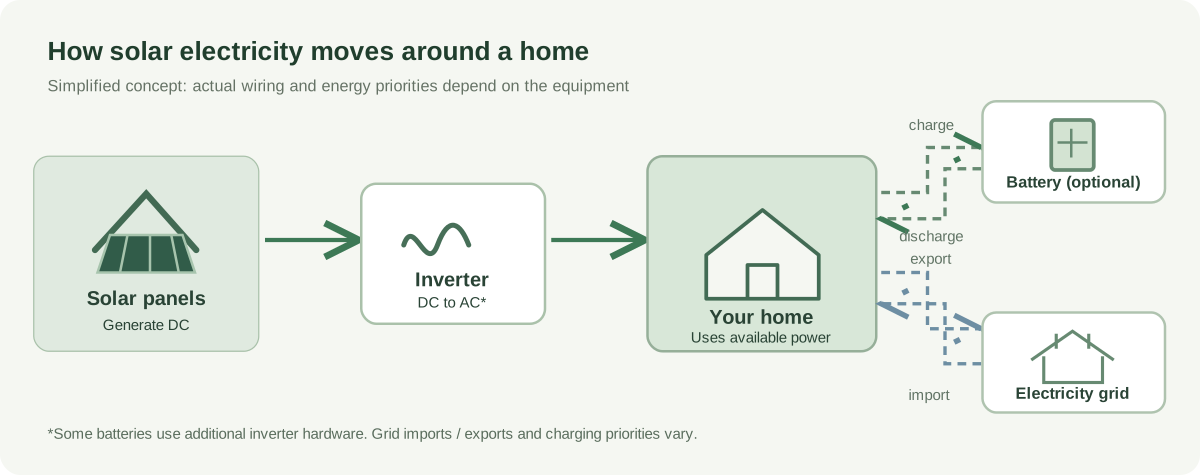
Sunlight arrives in tiny packets of energy called photons. Some photons give electrons inside the solar cell enough energy to move. The cell's internal electric field pushes those charges in a useful direction. Metal contacts collect them as direct-current electricity, and the inverter converts that DC electricity into the AC electricity your home uses.
The important correction to a common mental picture is this: a photon does not replace an electron or a molecule. It transfers energy. Think of the photon as giving an electron a shove, not taking its seat.
What is the difference between a solar cell, a solar panel and a solar system?
| Part | What it is | Simple analogy |
|---|---|---|
| Solar cell | The small semiconductor unit where the photovoltaic effect occurs | One tile |
| Solar panel/module | Many cells electrically connected and packaged together | A sheet made from many tiles |
| Solar array | Multiple panels connected on the roof | The whole tiled roof section |
| Solar system | Panels, inverter, wiring, protection, metering and optional battery equipment | The complete working machine |
When people say “solar panel,” they often mean the visible module on the roof. The actual conversion of light energy begins inside the individual photovoltaic cells within that module.
1. Sunlight arrives as packets of energy
Light behaves in ways that can be described as tiny packets of energy called photons. Different photons carry different amounts of energy.
Imagine the panel being showered with millions of tiny tokens. Each token carries some energy. Some bounce away, some pass through, and some are absorbed by the solar cell.
The panel does not “store sunlight” at this point. It is using the incoming light energy immediately.
2. The photon gives an electron enough energy to move
Most rooftop solar cells use silicon, a semiconductor. Its electrons are normally tied up in the material's atomic bonds. When the cell absorbs a photon with enough energy, that energy can free an electron to move through the material.
Picture electrons sitting in assigned theatre seats. A photon arrives with enough energy to let one person stand up and move into the aisle. The electron has not disappeared or been replaced. It has simply moved into a state where it can travel.
When that electron leaves its original position, it also leaves behind an empty place physicists call a hole. You can think of the empty seat appearing to move as neighbouring electrons fill it one after another.
3. The solar cell has a built-in way to separate charges
Freeing electrons is not enough. If they simply wandered around and immediately fell back into their old positions, we would get very little useful electricity.
Solar cells are engineered with differently treated layers of semiconductor material. Where those layers meet, they create an internal electric field that helps separate negative electrons from positive holes.
The photon gets someone out of their seat; the internal electric field is the sloped floor that encourages charges to move in opposite directions instead of immediately bumping back together.
This built-in field is a crucial part of the photovoltaic effect. It helps create the voltage that can push charge through an external circuit.
4. Metal contacts give the electrons a path around the circuit
The thin conductive lines you can see on many solar cells collect electrical charge. Once the solar cell is connected into a circuit, electrons can travel through the external wiring. That organised movement of charge is electrical current.
The solar cell has created energetic travellers and separated them. The wires are the road that lets them take a useful trip through the circuit instead of milling around inside the panel.
The electricity produced by the panels is direct current (DC): the electrical flow has a consistent direction.
5. The inverter translates panel electricity into household electricity
Australian homes use alternating-current (AC) electricity. Solar panels produce DC electricity, so an inverter sits between the panels and the home's AC electrical system.
The panels speak “DC”. Your house speaks “AC”. The inverter translates between them so the electricity can be used by household appliances.
Once converted to AC, the electricity can be used by the home. Depending on the system, surplus can charge a compatible battery or be exported to the grid. If the home needs more than solar and storage can supply, the balance comes from the grid.
What do solar panels actually do for a house?
They provide electrical energy whenever enough sunlight is available. In a normal grid-connected home, solar generated behind the meter reduces the amount the household needs to draw from the grid at that moment.
- House using less than solar is producing: the surplus can charge a compatible battery or be exported subject to the connection limit.
- House using more than solar is producing: solar supplies part of the load and the battery or grid supplies the balance.
- No useful sunlight: the solar array contributes little or nothing, so the home relies on storage or the grid.
The smart meter records the net electricity flowing through the grid connection. Solar used directly inside the home never needs to be imported through that meter.
Want the practical sizing version instead?
Read the Melbourne solar-panel guide or use the solar and battery calculator.
START MY ASSESSMENTWhat does a 6.6 kW or 10 kW solar system actually mean?
The kW rating describes power capacity, not how many kilowatt-hours the system will generate every day. A 6.6 kW array is 6.6 kW of rated panel capacity under standard test conditions. Real output changes through the day with sunlight, temperature, orientation, shading and system losses.
Think of kW as how fast the solar system can produce electricity at a particular moment, while kWh is the amount of electrical energy produced across minutes or hours.
The Australian Government's current consumer guidance gives Melbourne an illustrative annual-average generation figure of about 3.6 kWh per day for each 1 kW of panels. That means a theoretical 6.6 kW array would average about 23.8 kWh/day using that broad benchmark, but individual homes vary materially and generation is higher in summer and lower in winter.
That benchmark is useful for understanding scale, not for quoting a property. Roof direction, tilt, shading, equipment and local conditions need to be modelled for an actual system.
Do solar panels keep working during a blackout?
Ordinary grid-connected rooftop solar usually stops supplying power during a grid outage, even if the sun is shining. A standard grid-interactive inverter needs the grid or an equivalent stable AC supply to operate and must disconnect when the grid goes down.
This anti-islanding behaviour protects people working on the electricity network and prevents an ordinary solar system from energising wiring that is expected to be de-energised.
Keeping selected circuits running during an outage requires a system specifically designed for backup, such as a compatible battery, backup gateway or changeover arrangement. Having solar panels and a battery does not automatically mean every circuit or every phase will remain powered.
Do solar panels work on cloudy days or at night?
Cloudy days: yes. Diffuse sunlight still contains photons that can reach the cells, but output is usually lower than under strong direct sunlight. The exact reduction depends on cloud thickness, season, panel orientation and other conditions.
At night: rooftop PV does not produce useful electricity because there is no sunlight driving the photovoltaic process. A battery can supply previously stored energy, and the grid can supply the rest.
This is why annual generation estimates matter more than a single “perfect sunny day” output figure.
Why doesn't every photon become electricity?
Solar cells cannot convert all incoming sunlight into electrical energy. Some light is reflected. Some passes through. Some photons do not carry the right amount of energy to free a useful charge carrier, and energy above what the semiconductor can use can end up as heat. Electrons and holes can also recombine before their energy is collected.
Some balls bounce out, some take the wrong path and some lose their energy before reaching the scoring area. Solar-cell efficiency is partly about increasing the proportion that becomes useful electrical output.
This is also why panel temperature, shading, the angle of sunlight and the electrical design can affect real-world output.
Three things that are not happening
- Photons do not turn into electrons. The photon transfers energy to electrons already present in the semiconductor.
- The silicon is not used up like fuel. A solar cell is an energy converter, not a tank of material that is consumed every sunny day.
- Electrons are not created from nothing. The cell organises the movement of existing charge carriers through a circuit.
A compact way to remember the process is: light provides the energy, silicon provides the stage, the junction provides the direction, the wires provide the route, and the inverter makes the electricity useful to the house.
Quick solar-panel questions
Are photovoltaic panels different from solar panels?
“Solar panel” is a broad everyday term. Rooftop electricity-producing panels are photovoltaic, or PV, modules. Solar thermal collectors use sunlight for heat rather than producing electricity directly.
Do solar panels create electricity or store it?
They create electrical power from light while the light is available. Storage is the battery's job.
What is the difference between kW and kWh in solar?
kW describes the system's instantaneous power capacity. kWh describes energy generated or consumed over a period of time.
Do solar panels work if the grid goes down?
A standard grid-connected system normally shuts down during a blackout. Backup operation requires equipment specifically designed to isolate the home safely and create a stable supply for the circuits being backed up.
Does more sunlight always mean proportionally more power?
Not perfectly. Irradiance matters, but cell temperature, inverter limits, shading and electrical losses also affect output.
Why is the inverter important if the panels already make electricity?
The panels make DC electricity. The inverter converts it into grid-compatible AC and manages important operating and protection functions.
Sources and further reading
Editorial references checked: 21 October 2026Source labels identify who published each reference, not an independent endorsement. Confirm current requirements and exact product terms before purchasing.
- Government sourceAustralian Government: Solar panels ↗: Photovoltaic effect, standard test conditions, power versus energy, cloudy-day generation and Melbourne's broad annual-average generation benchmark.
- Government sourceAustralian Government: Inverters ↗: DC-to-AC conversion, grid-interactive inverter operation and why ordinary rooftop solar stops when the grid goes down.
- Government sourceSolar Victoria: Grid-connected solar explained ↗: How household loads, grid imports and surplus solar exports interact in a Victorian grid-connected home.
- Government sourceU.S. Department of Energy: PV Cells 101 ↗: Semiconductors, photon energy transfer, electron flow and metal contacts.
- Government sourceU.S. Department of Energy: Solar Photovoltaic Cell Basics ↗: Silicon semiconductor behaviour and photovoltaic conversion.