What size solar battery should you buy?
A useful starting point is the amount of electricity your home uses from late afternoon through the next morning, adjusted for how much of that load you genuinely want the battery to cover. Then check whether the battery has enough output power, whether your solar can recharge it through the year, and whether backup or future electrification changes the target.
Do not size a battery from household size alone. Two four-person homes can need very different storage if one uses electric heating, charges an EV and wants blackout backup while the other has modest evening demand.
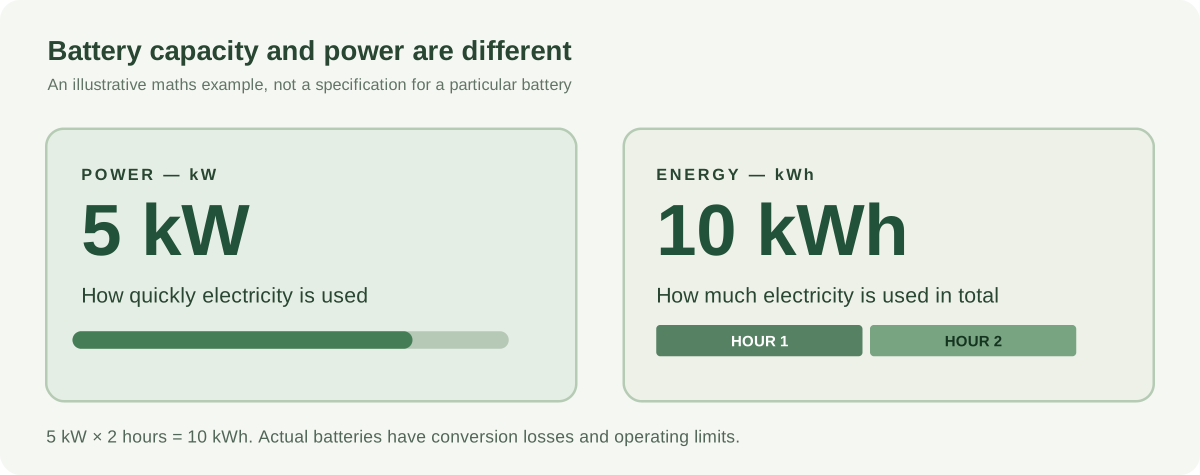
Battery capacity in kWh and power in kW are different
kWh is the size of the tank. It tells you how much usable energy can be stored. kW is the size of the outlet. It tells you how quickly the battery and inverter can deliver that energy.
Also distinguish nominal capacity from usable capacity. Nominal capacity is the total battery capacity stated by the manufacturer. Usable capacity is the amount the system makes available for normal cycling under its operating limits.
When comparing quotes, use usable kWh for household coverage and continuous kW for simultaneous loads.
Start with evening and overnight electricity use
If your goal is to reduce grid imports after solar production falls, look at smart-meter interval data from late afternoon through the next morning. That is more useful than taking the home's total daily consumption and assuming the battery must cover all of it.
Separate flexible loads from unavoidable loads. A dishwasher, hot-water cycle or EV may be shifted into solar hours or Victoria's free midday window. Refrigeration, lighting, cooking, heating and overnight background loads may be harder to move.
If a home typically imports 14 kWh between 4 pm and 8 am, that does not automatically mean it needs a 14 kWh battery. Some of that demand may be shifted, a backup reserve may reduce usable energy, conversion losses apply, and the home may not have enough winter solar to refill the battery every day.
Existing solar generation can limit the useful battery size
If you already have solar, use measured generation and import/export data where possible. A battery needs an energy source. If the solar system rarely produces enough surplus to refill a large battery, extra storage may spend much of the year partly empty unless grid charging is part of the strategy.
For a new solar-and-battery installation, model the array and battery together. A larger battery can justify a larger solar array where roof space and network approval allow it, especially for homes expecting more electric loads.
Battery sizing should survive the winter test
Melbourne solar generation is strongly seasonal. A battery that fills easily during long summer days may receive much less surplus solar in winter.
This is one reason a savings model should not assume the battery completes a full cycle every day of the year. Ask for monthly or seasonal modelling, not a single ideal-day diagram.
A larger battery can still be rational where grid charging, backup value or future loads matter, but the proposal should explain how often the additional capacity is expected to be used.
How does Victoria's free midday electricity window affect battery sizing?
From 1 October 2026, eligible Victorian households can opt into the Midday Power Saver, which provides up to 24 kWh of no-cost grid electricity between 11 am and 2 pm each day. A compatible battery may be scheduled to charge from the grid during that period.
This can make a larger battery more useful for some households because the battery is no longer dependent on rooftop solar alone for midday charging. But three hours of free electricity does not make unlimited storage economically sensible.
The battery must be able to accept energy quickly enough during the window, the household shares the 24 kWh daily allowance with other grid use, charging losses remain, and the electricity plan has priced periods outside 11 am to 2 pm. Compare the whole tariff, not just the free period.
Backup can change both battery kWh and output kW
A battery does not automatically power the house during an outage. Backup requires compatible equipment and a deliberate electrical design.
Decide whether you want a few essential circuits or broader whole-home backup. Refrigeration, lights and internet equipment need far less power than electric cooking, heating, pumps or EV charging.
Then check two numbers: how many kWh you want reserved for the outage and how many kW the battery can continuously supply in backup mode. A large battery with low output can still trip or refuse high simultaneous loads.
EV ownership and future electrification can justify future-proofing
EV charging, heat-pump hot water, induction cooking, electric space heating, pool equipment and additional air conditioning can materially increase household electricity demand.
Do not automatically add the EV's full battery capacity to the home battery. EV charging is usually a flexible load and may be better scheduled directly from solar or the Midday Power Saver window.
Future-proofing becomes more convincing when you know a major electric load is coming soon, the battery is modular, extra solar is available, or adding capacity later would require duplicated hardware or labour.
Why is “bigger is always better” wrong, and when is a bigger battery sensible?
A battery that is routinely too large for the available energy or household demand leaves expensive capacity unused. The federal battery discount also tapers for larger usable capacities, so support does not rise in direct proportion to battery size.
A larger battery can still be rational where the household has high evening consumption, wants meaningful backup duration, regularly has enough solar or free-window energy to fill it, expects near-term electrification, or values keeping a larger reserve for outages.
The right question is not “What is the biggest battery I can rebate?” It is “What extra job does the extra capacity perform, and how often?”
Use the battery calculator as the next step
The Melbourne Solar Guide calculator lets you work through household consumption, solar size, battery size and Victoria's free midday charging window together. It is designed to expose the assumptions, not produce a sales quote.
If you do not have useful interval data yet, the household builder can help map major appliances and when they run.
Sources and further reading
Editorial references checked: 5 October 2026Source labels identify who published each reference, not an independent endorsement. Confirm current requirements and exact product terms before purchasing.
- Government sourceAustralian Government: batteries ↗: Battery capacity, operation and system considerations.
- Government sourceAustralian Government: how solar and batteries affect bills ↗: Battery economics and the need to model actual household use.
- Government sourceVictorian Government: Midday Power Saver ↗: 11 am-2 pm no-cost period and 24 kWh daily allowance.
- Government sourceClean Energy Regulator: solar batteries ↗: Current federal battery eligibility and capacity-based STC tiers.