What happens when you install solar in Melbourne?
A good installation process starts before anyone climbs onto the roof. The design should be based on your electricity use, roof and future plans; the distributor connection should be understood before installation; and the final system must pass Victoria's electrical-safety process before normal operation.
- Understand your household and shortlist sensible system sizes.
- Compare written quotes using the same equipment, scope and assumptions.
- Confirm DNSP pre-approval and any export constraint.
- Complete rebate approval if a Solar Victoria incentive applies.
- Install the system to the approved design.
- Complete electrical certification and independent inspection.
- Finalise meter/export configuration where required.
- Receive monitoring, warranty and handover documents.
Start with your own electricity use.
Use the Melbourne Solar Guide calculator to establish a sizing starting point before comparing installers or package prices.
START MY ASSESSMENTFind the local questions for your suburb.
Our Melbourne suburb guides add local planning resources and questions to this installation checklist. For example, the Cheltenham solar guide explains starting points for Cheltenham homeowners. Roof conditions, distributor rules and eligibility still need to be checked for your actual address.
How should a Melbourne solar system be sized?
There is no single correct residential size. Start with your annual and daily electricity use, then look at when that electricity is consumed. Daytime use, evening demand, planned battery storage, EV charging, heat-pump hot water, electric heating and cooling can all change the answer.
Roof space and network limits matter too. A 6.6 kW array on a 5 kW inverter remains common, but many electrified homes can justify modelling 8 kW, 10 kW or larger arrays where the roof and connection allow it.
Ask the retailer to explain the recommended panel capacity, inverter capacity and expected annual generation separately.
What should be assessed about the roof and property?
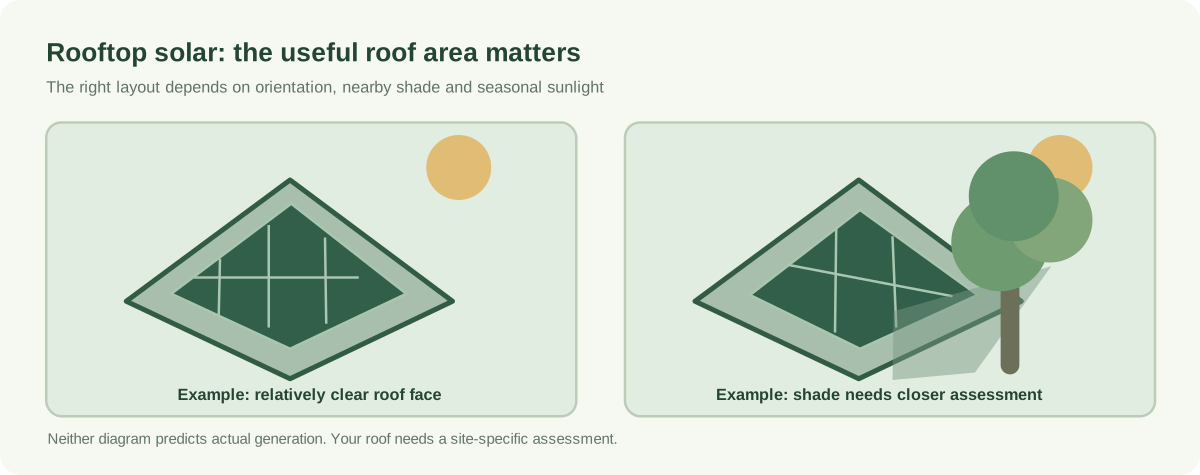
The design needs to account for usable roof area, orientation, shading, roof condition, access, switchboard condition, meter arrangement and practical inverter location. Satellite imagery can resolve many straightforward properties, while a physical property visit becomes more useful when important details cannot be confirmed remotely.
Solar Victoria notes that many credible retailers quote remotely. A remote quote is not automatically weaker, but the final design still needs to reflect the actual property. If real conditions materially differ from the proposal, design or price changes should be explained before work proceeds.
What should a solar quote include?
A useful quote identifies the exact panel and inverter models, array size, inverter output, layout, generation assumptions, network/export assumptions, installed price, incentives, known exclusions and warranty responsibilities.
If a battery is included, also record usable kWh, continuous output kW and backup capability. If finance is included, compare the total repayable amount rather than only the weekly repayment.
Use the solar quote comparison framework and downloadable table ↗
What is the difference between the solar retailer and the installer?
The retailer is usually the business that sells the system, prepares the proposal, manages the contract and coordinates the project. The installer is the licensed and accredited person or team performing the regulated installation work.
They may be the same business or separate businesses. Subcontracting is common and is not automatically a problem. The ACCC says that when one business sells both the products and installation, that business generally remains responsible for consumer-guarantee remedies even if it used a subcontractor.
For Solar Homes work, retailers and installers must also meet Solar Victoria's program requirements.
Why does DNSP pre-approval matter before installation?
Melbourne is served by several electricity distribution networks. The distributor controls the technical connection and can place conditions on inverter capacity and export.
Solar Victoria requires participating retailers to obtain pre-approval from the relevant distribution network service provider and explain any export constraint. Ask for that connection outcome in writing before the installation proceeds.
What should good solar workmanship look like?
Good workmanship is more than neat panel rows. The mounting should be secure, cable and conduit work protected, penetrations weatherproof, equipment locations compliant, labels clear and electrical protection appropriate to the system.
Solar Victoria's technical audit guidance highlights recurring safety issues such as weather and water protection, conduit treatment and equipment installation. You do not need to become an electrician, but you should expect the retailer to take responsibility for a compliant installation and to explain anything that changed from the agreed design.
Why can the system be installed but still left switched off?
In Victoria, solar PV and battery installations are prescribed electrical work. Energy Safe Victoria requires an independent Licensed Electrical Inspector to inspect prescribed work before it can be turned on or left turned on.
Energy Safe says this inspection should be completed within 8 business days of completion of the electrical work. That can mean a normal wait of several days after the physical installation.
Read the focused Victorian inspection guide ↗ or see the full quote-to-grid process ↗.
When do exports and feed-in credits start?
Electrical inspection, meter configuration and export/billing administration are related but separate steps. Depending on the distributor and electricity retailer, export credits may not appear immediately after the panels are installed.
Your network approval determines the export arrangement. A larger solar array can still be useful when exports are limited because the household can use solar directly or charge a compatible battery before surplus reaches the export ceiling.
What warranties should you receive?
Keep the panel product warranty, panel performance warranty, inverter warranty, any battery warranty and the retailer or installer's workmanship warranty as separate documents. They cover different failures.
Your Australian Consumer Law rights sit alongside those written warranties. Ask who you contact first, whether labour is included in a manufacturer replacement and what happens if the original retailer stops trading.
How should you compare solar installers in Melbourne?
Look beyond the headline package price. Consider trading history, workmanship support, who performs the installation, technical capability, after-sales support, customer-review depth, local accountability, product range and how clearly the proposal states assumptions and exclusions.
Use the same evidence-based checks across several providers. Melbourne Solar Guide does not rank installers or require you to submit an enquiry to use its guides and planning tools.
See how to compare Melbourne solar installers ↗ and review the Victorian installer red flags ↗.
Sources and further reading
Editorial references checked: 5 October 2026Source labels identify who published each reference, not an independent endorsement. Confirm current requirements and exact product terms before purchasing.
- Government source
- Government source
- Government sourceSolar Victoria: consumer protections ↗: Retailer obligations, DNSP pre-approval and system-design responsibilities.
- Government source
- Government source